- Stretching guide
- Hips
- After sitting
Hip stretches after sitting all day
A long day in a chair leaves the front of your hips feeling short and your bottom muscles half asleep. These gentle moves help you stand up tall again.
 By JPott Studios
About a 7 minute read
Hip stretches after sitting all day work best when they do two things: open the front of the hip and wake up the muscles in your bottom. Walk around for a minute first, then try the six-minute standing routine below.
Why do hips get so stiff? When you sit, they stay bent at roughly a right angle for as long as you stay put. The muscles at the front of the hip spend the day shortened, and the big muscles of the bottom barely have to work. So the first few steps after a long sit can feel creaky, and some people feel it in the lower back too.
Hips usually respond well to a little regular attention. There are also a few moves lying down for the evening, and some you can do without leaving your chair.
Before you start. This is general information, not medical advice. Move only within a comfortable range and stop if anything hurts. If you've had a hip or knee replaced, ask your surgeon or physiotherapist which of these suit you, because some positions, such as crossing the legs, may be off limits for a while. The same goes for any hip or back injury, a health condition, or pregnancy.
Start by standing up
Muscles that have been still for hours like to warm up before they stretch. Stand up and walk around the room or down the hall for a minute, letting your arms swing. Then begin.
Hip stretches after sitting all day: the standing routine
Keep a sturdy chair, counter or wall within reach for balance. This part takes about six minutes.
-
Standing march 40 seconds
Hold the chair if you like. Lift one knee to a comfortable height, lower it with control, then lift the other. An easy, steady pace is perfect. -
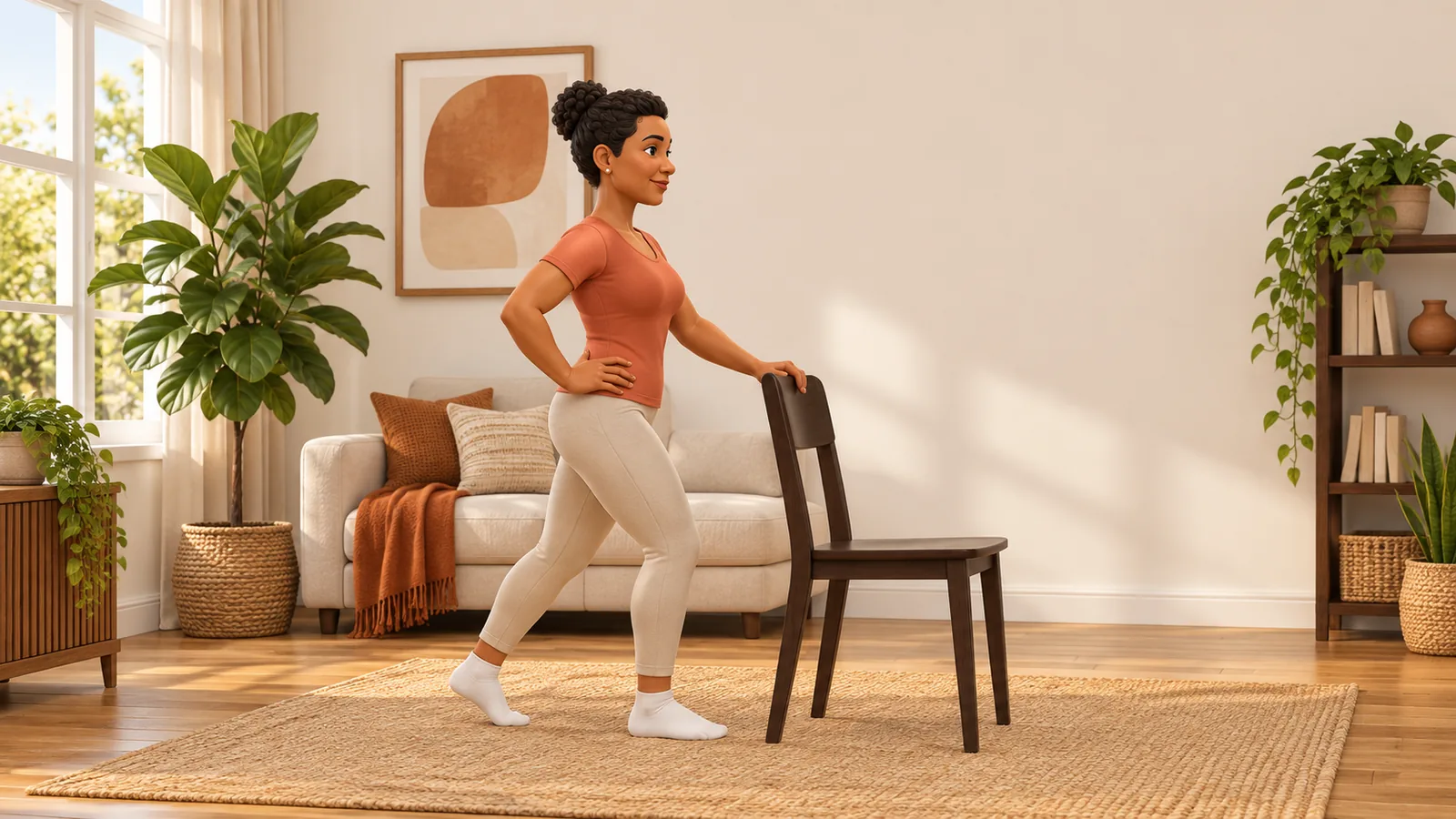
Standing hip flexor stretch 30 seconds each side
Hold the chair back or counter and take a short step back with one foot, letting that back heel lift. Stay tall through your upper body. Gently tuck your tailbone under, as if drawing your belt buckle up a little, and bend both knees slightly. You should feel a stretch at the front of the back hip. Keep the lower back from arching. -
Standing quad stretch 30 seconds each side
Hold the chair with one hand. Bend one knee and hold that ankle, or the leg of your trousers, behind you with your knees close together. Can't reach? Loop a towel or scarf around the ankle. You'll feel it along the front of the thigh. -
Standing figure-4 30 seconds each side
Hold the counter with both hands and cross one ankle over the opposite thigh, just above the knee. Then sit your hips back a little, as if lowering into a chair. You should feel it in the outer hip and bottom of the crossed leg. Keep it small until your balance feels settled. -
Hamstring reach 30 seconds each side
Put one heel forward with the toes lifted and the knee soft. Rest your hands on your thighs and tip forward from the hips with a long back until you feel the back of that leg. -
Side lunge shift 30 seconds each side
Stand with your feet wide. Bend one knee and shift your weight over it, keeping the other leg long, then come back to centre. You'll feel it in the inner thigh of the straight leg.
The standing routine at a glance
Each block is one move, sized by how long it lasts.
Lower back complaining too? Pair this with our 5-minute desk stretches for a stiff back.
Lying down, if you like
These feel lovely in the evening on a mat, a rug or a firm bed, and add about three minutes. On a soft mattress, try the gentle stretches you can do in bed instead.
-
Knee to chest 30 seconds each side
Lie on your back with your knees bent. Hug one knee gently toward you, holding behind the thigh, while the other foot stays on the floor. -
Lying twist 30 seconds each side
With both knees bent and feet flat, let both knees fall slowly to one side while your shoulders stay heavy. Tuck a pillow under your knees if they don't reach the floor. -
Glute bridge 30 seconds
Feet flat and hip width apart. Press through your feet and lift your hips a little, then lower slowly. Five to eight slow lifts wake up the muscles that sitting switches off. -
Reclined butterfly 40 seconds
Put the soles of your feet together and let your knees fall open. Rest a cushion under each knee if the stretch feels too strong, and breathe.
Can you stretch your hips without leaving your chair?
Yes. Slip these in between emails or while the kettle boils:
- Seated figure-4. Cross one ankle over the opposite thigh and tip forward a little from the hips. If crossing is too much, rest the ankle on the shin instead.
- Seated march. Lift one foot a little off the floor, lower it, then the other. Twenty easy lifts wake up the front of the hips.
- Seated hamstring stretch. Reach one heel forward, toes up, and tip forward from the hips.
- Sit to stand. Stand up and sit down slowly five times. It stretches, strengthens and gets you out of the chair, all at once.
For a longer seated set, try our chair stretches for older adults, or follow the free 5-minute desk stretch timer.
From JPott Studios
One calm email a month
One useful tip, one free printable or tool, and a short note from our apps. Join and get the free welcome pack: printable trackers, a packing list maker and more.
What should a hip stretch feel like?
You want a mild, even stretch that eases as you breathe. A pinch in the crease at the front of the hip, a sharp feeling behind the knee, or tingling down the leg all mean it's time to come out of the stretch. Try a smaller version, or leave that one out for today.
A mild stretch, or time to stop?
What to look for in every hip stretch.
You are looking for
- A mild, even stretch
- A feeling that eases as you breathe
Come out of the stretch if you feel
- A pinch in the crease at the front of the hip
- A sharp feeling behind the knee
- Tingling down the leg
Sit less, in small ways
No stretch fully undoes eight hours of stillness, and it doesn't have to. Small breaks spread through the day add up:
- Stand up for phone calls, or walk while you talk.
- Use a smaller water glass so you get up more often to refill it.
- Change how you sit now and then: feet flat, one foot tucked, perched forward. Variety is the point.
- Set a gentle reminder every 45 to 60 minutes, and let it mean "stand up", not "work harder".
Flying soon? A plane is the same problem in a smaller seat, so pack these stretches for long flights too.
In Gentle Range, the free Chair Session includes a seated figure-4 and a seated hamstring stretch you can do at your desk. The Hips & Legs routine, made for exactly this kind of day, and the slower Hip Reset are part of the full library.
Questions people ask
How long should I hold a hip stretch?
Around 20 to 30 seconds on each side is a common starting point. Breathe slowly the whole time and let the stretch ease rather than pushing further. Some people like a second, gentler round.
Why do my hips still feel tight even though I stretch?
Stiffness after sitting often has as much to do with staying still for hours as with the muscles themselves, so getting up often matters as much as stretching. If the tightness doesn't ease over a few weeks, or it comes with pain, a physiotherapist can help work out why.
Should I stretch before or after a long sit?
Either is fine, and small breaks during the sit are even better. A couple of chair moves every hour, plus a short standing routine when you finish for the day, suits most people.
What if I feel a pinch at the front of my hip?
A pinch in the crease at the front of the hip means that position isn't right for you today. Come out of it, then try a smaller range or a slightly different angle. If the pinch keeps coming back, ask a physiotherapist.
From JPott Studios
One calm email a month
One useful tip, one free printable or tool, and a short note from our apps. Join and get the free welcome pack: printable trackers, a packing list maker and more.