- Stretching guide
- At your desk
- Back and shoulders
Desk stretches for a stiff back: a 5-minute chair routine
Nine small moves you can do without leaving your chair. No mat, no changing clothes, and about five minutes from start to finish.
 By JPott Studios
About a 6 minute read
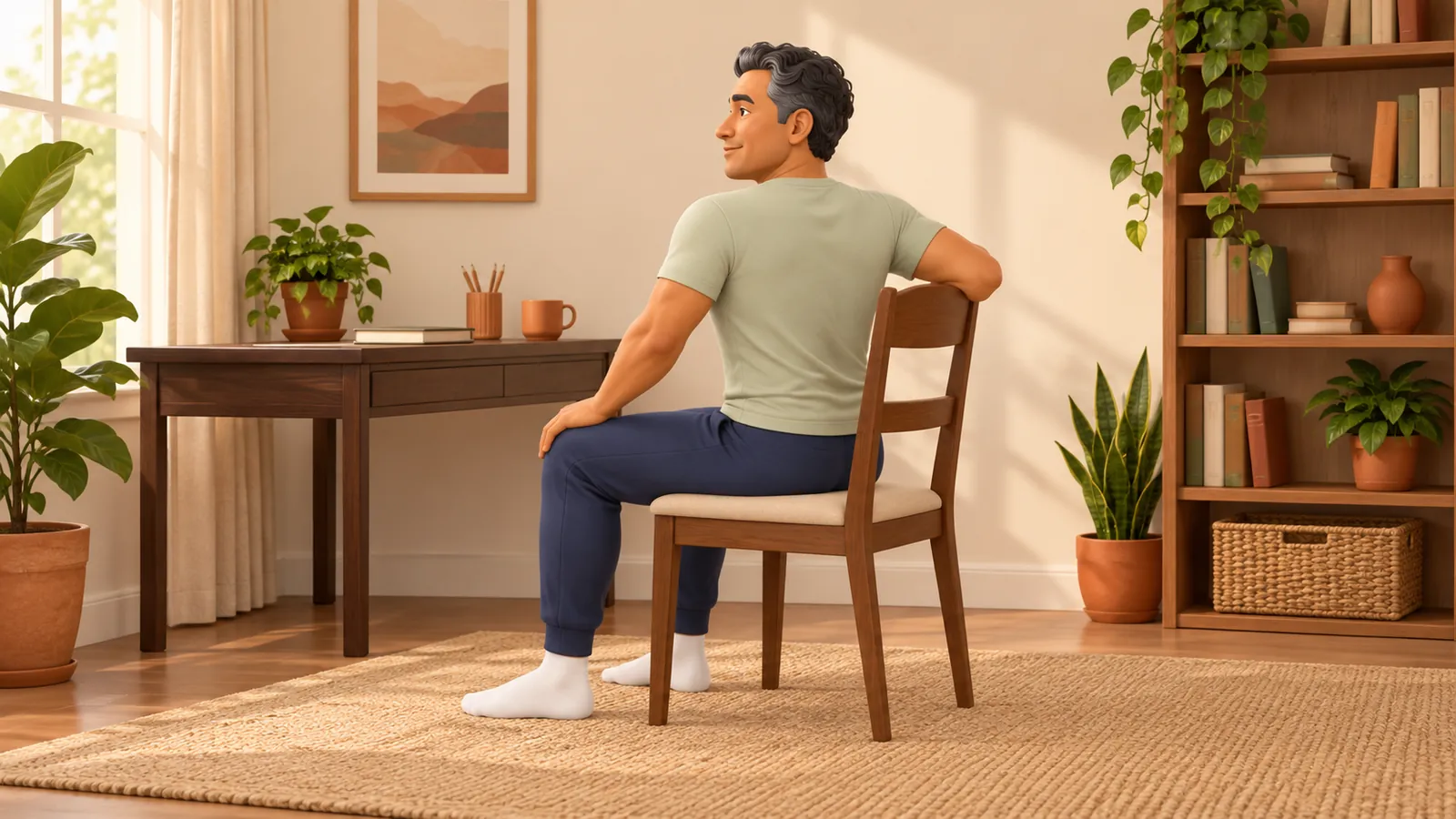
Good desk stretches for a stiff back are small ones you can do right in your chair: a slow breath, a few neck and shoulder moves, a gentle twist and a fold. Nine of them fit into about five minutes, and nobody on your video call needs to know.
Sitting still is most of what a desk asks of you, and bodies aren't built for it. After an hour or two your upper back starts to round, your shoulders creep up, and your neck feels like it's holding something heavier than a head.
A short break that moves you in a few directions often feels better than one big stretch. So this routine starts with your breath, moves through your neck and shoulders and then your upper back, and ends with a slow fold.
Before you start. This is general information, not medical advice. Move only within a comfortable range and stop if anything hurts. If you have a back, neck or shoulder injury, a health condition, or you are pregnant or recovering from surgery, check with a doctor or physiotherapist first.
How should you sit before you start?
Scoot to the front of a steady chair, ideally one without wheels. Put your feet flat on the floor about hip width apart, and let your weight settle evenly on both sit bones.
You don't need to sit perfectly straight. Just sit tall enough that you're not slumped into the backrest. That's the whole setup.
Desk stretches for a stiff back, move by move
Treat the times as a guide, not a rule. Breathe normally the whole way through, and never hold your breath to push a little further.
-
Big breath 30 seconds
Sit tall. Breathe in comfortably, then let the out breath take a little longer than the in breath, without forcing it. Your ribs should widen as you breathe in, and your shoulders should soften as you breathe out. -
Shoulder rolls 30 seconds
Roll both shoulders backward in big, slow circles: up toward your ears, back, down and round. Let your shoulder blades glide and settle down your back. Big circles feel like too much? Make them smaller. -
Chin tucks 25 seconds
Gently draw your chin straight back, as if you're making a small double chin. Keep your eyes level, so the chin travels straight back and not down. It's meant to be a tiny movement. You might feel a mild stretch at the base of your skull. -
Ear to shoulder 20 seconds each side
Let one ear drop toward the shoulder on the same side and let it settle there. Don't pull on your head, and don't lift the shoulder to meet it. You should feel a gentle line of stretch up the other side of your neck. Come back to centre slowly, then do the other side. -
Cross-body stretch 20 seconds each side
Bring one arm across your chest and hold it with your other hand, just above or below the elbow rather than on the joint itself. Ease it a little closer. You'll feel a broad stretch across the back of that shoulder. Then swap arms. -
Chest opener 25 seconds
Clasp your hands behind your back. If that's uncomfortable, hold a scarf or towel between them instead. Lift a little, just enough to feel the front of your chest widen, and try not to arch hard through your lower back. -
Seated cat-cow 30 seconds
Rest your hands on your knees. As you breathe in, open your chest and let your upper back arch a little. As you breathe out, round your upper back and let your head follow. Move slowly between the two, like a wave rolling through your spine. -
Seated twist 20 seconds each side
Sit tall. Turn your chest to the left and rest your left hand on the back of the chair or beside you. Come back to centre, then turn to the right. Let your chest lead, not your neck, and don't haul on the chair to go further. -
Seated chair fold 40 seconds
Slide your hands down your thighs and fold forward between your knees, only as far as feels comfortable. Let your head and arms hang heavy. Come up slowly at the end, rolling up one part at a time, so you don't feel light-headed.
Your five minutes at a glance
Each block is one move, sized by how long it lasts.
Add those times up and you get exactly five minutes. Rather not watch the clock? Our free 5-minute desk stretch timer walks you through these same nine moves one at a time, with a countdown for each.
Your neck may want more attention than the rest of you, especially after a long day on a laptop. For that, try these neck and shoulder stretches for screen tension, which also cover how to raise your screen so it pulls on you less.
What should desk stretches feel like?
A good stretch is a mild, even pull that eases a little as you breathe. It should never feel sharp, pinching, burning or tingly.
If it does, come out of the move. Make it smaller next time, or skip it altogether. Skipping a move is a perfectly good choice.
Some people feel looser straight away. Others notice very little the first few times, and that's normal too.
A mild pull, or time to stop?
A quick check for every move.
A good stretch feels
- A mild, even pull
- Easing a little as you breathe
- Looser straight away, or very little at first. Both are normal
Come out of the move if it feels
- Sharp
- Pinching
- Burning
- Tingly
From JPott Studios
One calm email a month
One useful tip, one free printable or tool, and a short note from our apps. Join and get the free welcome pack: printable trackers, a packing list maker and more.
How to make desk stretches a habit
The easiest way is to tie the routine to something you already do. Stretch after a meeting ends, while the kettle boils, or just before lunch.
On busy days, keep it small. Two moves still count, and shoulder rolls plus a chair fold take about a minute.
If your back is stiffest first thing, a short morning stretch routine for beginners can loosen you up before you even sit down.
Get up now and then, too. Stretching in your chair is good, and so is walking to the window and back. Do both when you can.
If the same spot aches every afternoon, take a look at your setup. The height of your screen or chair may be part of the story.
Long days in a chair can leave your hips tight as well, so hip stretches after sitting all day pair nicely with this routine. And if your hands do most of the work at your desk, add a few wrist and hand stretches for typing.
In the Gentle Range app, the free Neck & Shoulders routine and the free Chair Session use many of these same moves, with a timer that carries you from one to the next.
Not sure a desk break is the right fit for you? Our stretch break quiz asks seven quick questions and suggests a gentle break for your kind of day, from desk and morning to bedtime, travel or chair.

From JPott Studios
One calm email a month
One useful tip, one free printable or tool, and a short note from our apps. Join and get the free welcome pack: printable trackers, a packing list maker and more.